|
 |
The
result of a Connecticut company's "Yankee Ingenuity" is
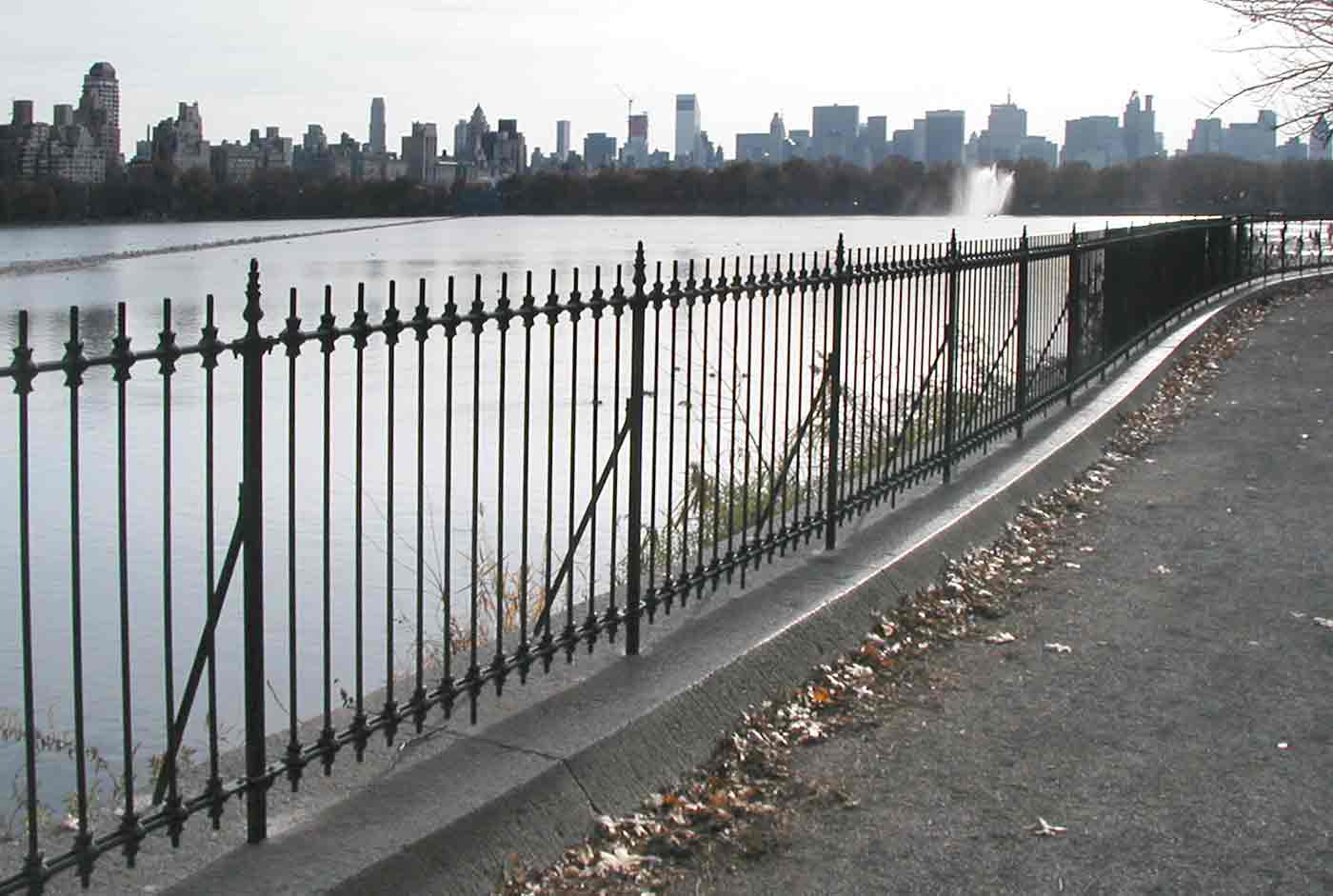
now being appreciated by our neighbors in New York City. Welding
Works, Inc. of Madison, Connecticut recently completed a brand-new
fence to replicate the one that surrounded the Central Park Reservoir
from 1862 until 1926. The original ornamental fence was unique in design
and construction, unlike any fencing normally being produced today. |
 |
|
 |
| Project
Details |
| Fence
is approximately 8,150 feet long and 48 inches high. |
| Welding
Works utilized reverse engineering and time-proven methods
in order to meet schedule and budget demands. |
| Fence
panels and posts contain no visible fasteners, pins or welds. |
| All
weldments are accurate within ±.015 inches. |
More
than 1,400 cast
iron molds were used to create 19 panel mold assemblies and 16 post mold
assemblies. |
The
fence posts can
support more than 900 pounds of pressure with no permanent deflection,
meeting or exceeding existing codes. |
| Welding
Works fabricated 1,535 fence panels, each 5 feet 6 inches long,
with 26 castings per panel. |
| Each
panel is joined by a post, for a total of 1,538 posts, each
with 2 castings. |
| In
total, the project encompassed more than 43,000 castings. |
|
 |
| Welding
Works' Vice President, Walter Camp; and President, Price
van der Swaagh |
| Welding
Works would like express their gratitude to the following
for their involvement in this meaningful project: |
| Marvin
and Donna Schwartz |
| Central
Park Conservancy – Christopher Nolan and James Reed |
| Case
Patterns & Wood Products – Jim Case, President |
| Cumberland
Foundry Co., Inc. – Al Lucchetti, President |
| G&W
Foundry Corp. – Jim and Dick Bruso, owners |
| Nashua
Foundries, Inc. – Peter Lyons, President |
| Advanced
Coring & Cutting Corp. – Stanley Lisowski, President |
| Viking
Enterprises, Inc. – David Engdall, President |
| General
Sandblasting – John Rudnicki, President |
| Teknicote – Steve
Dolan, President |
| New York
City Ornamental Iron Workers – Local 580 |
|
|
Welding
Works was challenged to "think outside of the box" to deal with the complexities
of the project. They used reverse engineering and investigated technologies
used in the past to develop a workable design, fabrication and installation
plan.
The 1860s fence
design was unique in several ways. Its finials and ornamental unions
were cast around, not fastened to, its pickets and rails. The only
mechanical fasteners used were to join the panels to the posts. When
this aesthetically pleasing fence was removed in 1926, it was replaced
by 7-foot chain link, which did a fine job of protecting the water
in the Reservoir, but, at the same time, obstructed the beautiful
view for those walking in that area of the Park.
 |
| In
total, the fence re-creation project encompassed 43,000
castings. |
|
Thanks to a generous
donation by Marvin and Donna Schwartz, who live near the Park,
the Central Park Conservancy was able to undertake the re-creation
of the original fence. This replica would be installed on existing
coping stone and would
measure approximately 8,150 feet in length and 48 inches high, an adequate
height, since the Reservoir is no longer used to supply drinking
water.
The Park Conservancy
initiated competitive bidding among established contractors with
a proven track record working on projects of
this magnitude. Welding Works, who had done work for the Conservancy
in the past, was one of seven qualified bidders. In preparing
their
bid, they examined how the original fence was fabricated and
rediscovered the earlier casting technology that was used in
1862. They were
thus
able to formulate fabrication and installation plans that would
meet the Conservancy's completion schedule at a less-than-astronomical
price.
As Christopher
Nolan, the Conservancy's Vice President for Capital Projects, put
it, "Many of those who were originally
interested
in bidding on the fence project later said that they didn't
think it could be done. The people at Welding Works put their
heads
together and figured [the complexities of the project] out,
and we awarded
them the contract."
The original fence
was held together by the castings; therefore, no fasteners, pins
or welds could be
visible. Since the new
panels were
to be of welded construction, one of the project's biggest
challenges was to develop the manufacturing methods to
cast around the weldment
in a cost-effective, productive manner. Precise assembly
fixtures were required for accuracy, since weldments needed
to be ±.015
inches to ensure that the mold would fit snug and that
the final product would
be correct. The weld fixture held the steel posts in place
with pneumatic clamps and enabled two workers to weld at
the same time.
Welding Works
had a tangible plan as to how the castings would be made so that
they matched the original
fence.
They worked
hand-in-hand with
mold designer Jim Case to design a unique 3-piece mold.
This mold would not only ensure that sufficient iron
got into
the mold and
filled all
the gaps, but it could also be removed without damaging
the casting. Since the iron would solidify almost instantly,
it was a challenge
to get good, tight, full castings. Case created a sandcap
pouring basin that allowed extra metal to feed the mold
to
compensate
for shrinkage
during cooling. In speaking of Welding Works, Case said, "They
went out of their way to get the job done right, with
a high level of craftsmanship."
Ultimately, over
1,400 cast iron molds were used to create 19 panel mold assemblies
and 16 post mold assemblies. Before casting the unions on the panels,
comprehensive load tests were performed to ensure that the fence
would comply with the latest code of 200 pounds of force. It was
determined that the posts could support over 900 pounds of pressure
with no permanent deflection.
|
 |
| The
completed fence now offers an unobstructed view of
the Reservoir and the Manhattan skyline. |
|
Welding Works
fabricated 1,535 fence panels, each 5 feet 6 inches long, with 26
castings per panel. Each panel was joined by a post, for a total
of 1,538 posts, each with 2 castings. In total, the project encompassed
more than 43,000 castings.
All installation
procedures were developed and tested at Welding Works before attempting
installation on site. Walter Camp, Welding Works' Vice President,
explains, "Generally, on a field installation, you would have
the opportunity to problem-solve and perfect the procedure as you
go along. With such a tight schedule, we had to perfect the installation
methods beforehand."
Welding Works'
President, Price van der Swaagh, refers to the Central Park Reservoir
Fence as "one of the most dramatic projects we've ever done." He
continues, "It was gratifying to be involved in such a public
project."
The fence was
completed and dedicated in December of 2003. It has been called "the
single most dramatic change to the Park in 100 years." It provides
an unobstructed view of the Reservoir, as well as of the Manhattan
skyline. There have been virtually no negative comments about the
project. The Central Park Conservancy's Christopher Nolan reports, "The
fence has been very well-received. It restores the historic aesthetic
of the Reservoir and changes people's entire perception of Central
Park."
The American Fence
Association evidently also appreciates Welding Works' efforts on
this project. The organization just announced that we have received
their Fence Project of the Year Award for the re-creation of the
original Central Park Reservoir fence. As the American Fence Association
states, "The Fence Project of the Year Award is bestowed upon
the company that has demonstrated unique workmanship and exemplary
knowledge of fence installation."
Click
here to view more photos of the Central Park Fence project. |
| |
| TOP OF PAGE |
 |
| Welding
Works fabricated sixteen of these 14-ton carbon steel modules
to fit the customer's
existing air heater shells. |
|
Welding Works Uses Both Design and Fabrication Expertise in Air Heater
Module Project
The production of
new air heater modules for a power plant in eastern New York State
is a good illustration of how Welding Works combines
design
and fabrication skills. Sixteen all carbon steel modules needed to
be fabricated to fit into an old asbestos-insulated heater shell.
To
prepare the shell, the customer cut out the bottom of the old heater
and the nonoperational mechanisms were removed. The only materials
provided to Welding Works for the project were
the dimensions of the air-heater modules and the metal tubes that
were
to be installed
in the modules. Welding Works was responsible for designing the support
structure for the tubes, as well as the shipping skids for the modules.
The
sixteen 4-foot x 7-foot x 19-foot modules, each weighing over 14
tons, were fully fabricated at Welding Works. Each module was
transported
on
its own flatbed truck, ready to install upon arrival. (It should
be noted that all of the asbestos in the shell was properly sealed
and
contained.)
TOP OF PAGE |
Welding Works Adds
New Equipment to Serve You Better
Recent
additions to our facilities include a new 6,000 pound lift truck and
a 220 ton, 4 meter hydraulic press brake. Our 300 ton press brake
has also been rebuilt to improve accuracy.
|
TOP OF PAGE
|
| RETURN
TO NEWSLETTER DIRECTORY
|
|